
>>_
SDR for Hackers: A Beginner’s Guide to Anti-Drone Signal Intelligence
## Introduction
Drones have revolutionized modern operations from surveillance to precision strikes, but they all share a critical weakness: their lifeline is the radio frequency spectrum. Without it, they can’t communicate, navigate, or complete their missions. This makes the electromagnetic spectrum one of the most contested battlefields today.
In Radio-Electronic Warfare, the mission is clear: disrupting the enemy’s ability to coordinate and control. One powerful tactic, known as COMJAM (communications jamming), targets the very channels unmanned aerial vehicles (UAVs) rely on. By interfering with these signals, it’s possible to confuse, disable, or even take control of drones.
## Understanding Radio-Electronic Warfare
Traditional warfare is about controlling the land and sea, but Radio-Electronic Warfare (REW) is about controlling the airwaves. In the context of UAV jamming, the focus is on high-stakes electronic operations designed to manage unmanned aerial activity.
>_ Main Goals of Electronic Warfare
- Cut the Connection: Every drone has an invisible string connecting it to the pilot’s remote. We use technology to cut that string. Once the connection is broken, the pilot loses control and the drone doesn't know what to do.
- Blind the Camera: Drones are used to spy and take videos. We blind the drone by blocking its ability to send pictures or videos back to the enemy. If they can’t see where they are going, they can't cause trouble.
- Keep Our Own Radios Working: It’s easy to block all signals, but that would also stop our own teams from talking to each other. The real trick is to block the bad drone signals while making sure our "good" radios and phones still work perfectly.
## What is COMJAM?
COMJAM is short for Communication Jamming. It is the easiest way to stop a drone without ever touching it.
Imagine you are trying to listen to a friend across a room, but someone suddenly stands next to you and screams loudly. You can’t hear your friend anymore; the loud noise has blocked the message.
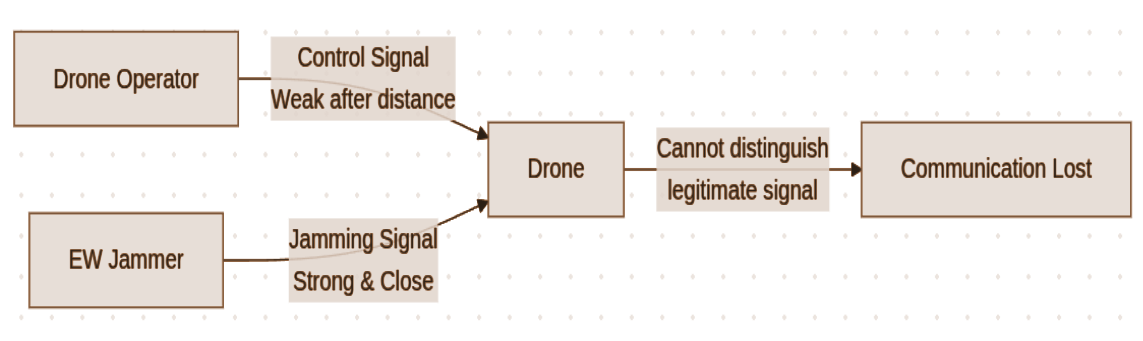
That is exactly how we stop a drone:
- We send out a "radio scream" on the same channel the drone is using.
- The drone gets confused because it can no longer hear the pilot’s remote.
- Because it’s lost, the drone usually does one of three things:
- It lands right where it is.
- It hovers in the air until the battery runs out.
- It goes "home," which actually shows us exactly where the pilot is hiding.
## How Jamming Actually Works
Jamming is just like being at a concert; if your friend whispers, you won’t hear them because the music is blasting. To hear your friend, their voice has to be louder than the background.
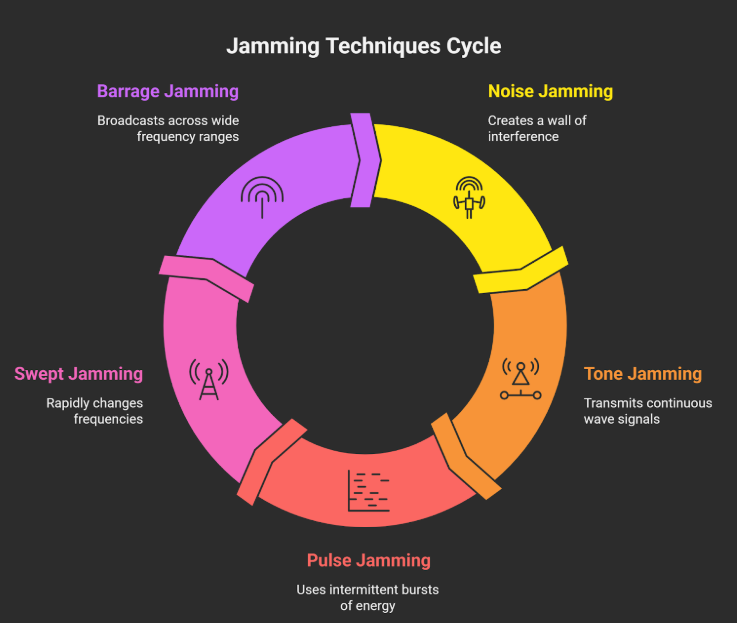
In drone terms, this is called the Signal-to-Noise Ratio (SNR): the balance between the pilot’s signal and all the interference around it. Stopping a drone doesn’t always mean shooting it down. Instead, counter-drone technology disrupts control signals through:
- Jamming: Using electromagnetic noise to drown out communication.
- Spoofing: Where a third party impersonates the pilot's control signals.
>_ Types of Jamming Signals
- Smart Jamming: Basic jamming is like shouting to drown out a conversation. Smart Jamming is more like identity theft. Instead of just making noise, a smart system listens to the drone’s signal, copies it, and sends back a fake version that the drone thinks is real.
- Spoofing (Digital Kidnapping): This is where we trick the drone’s GPS. We make the drone think it is at an airport when it’s actually over a forest. This can force a drone to fly away or land in a spot where we can capture it.
## What Happens to a Drone When It’s Jammed?
When we hit the jam button, the drone usually reacts in one of three ways depending on the target:
| Reaction | Effect on Drone |
|---|---|
| Lost Connection | The drone loses its link to the pilot. It may hover like a statue or trigger "Auto-Home." |
| GPS Blindness | Without GPS, the drone loses its orientation. Some will drift with the wind and eventually crash. |
| Black Screen | We blind the camera feed. If the pilot is flying FPV (First Person View), they suddenly see static—like driving a car blindfolded. |
## The Anti-Drone Toolkit: From Backpacks to Trucks
Not every shield is the same size. Depending on the mission, different tools are used:
1. The Big Shields (Vehicle Systems)
These are large units mounted on trucks or at bases.
- AUDS: A powerful system that can stop drones from miles away.
- M-LIDS: An all-in-one defense. It jams the drone, but if that doesn't work, it features a cannon and "guard dog" drones to hunt the intruder.
- Russian Units (Silok & Repellent): Mobile truck-based stations. The Repellent system can shut down drone signals from up to 30 kilometers away.
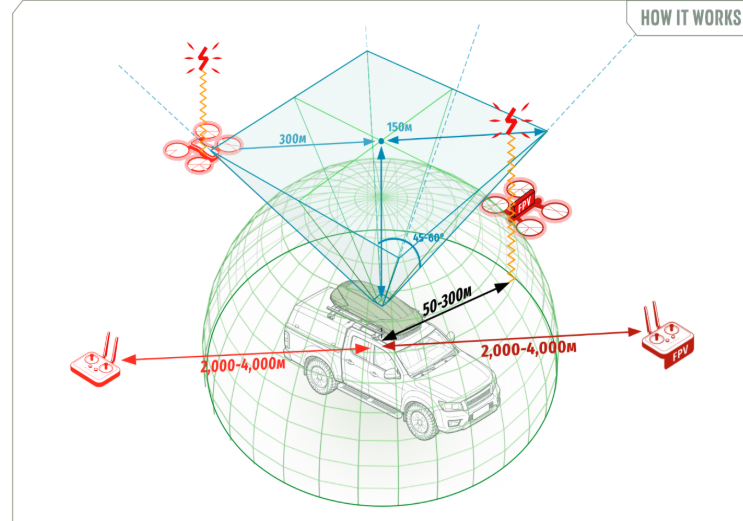
2. The Personal Bubble (Wearable Tech)
Soldiers on the move use portable tech like the UNWAVE series.
- The Shatro: A wearable protective bubble that creates a 100-meter safety zone around a person.
- The Boombox: A small, portable device acting as a digital wall. It blocks remote controls, GPS, and Wi-Fi video feeds.
## Conclusion
The invisible war in our skies is just getting started. To stay safe, we don't always need to shoot drones down; we just need to win the shouting match against their signals. By using tools like COMJAM, we turn a high-tech threat into a harmless piece of drifting plastic. Whether it’s a giant electronic shield or a small protection bubble in a backpack, the goal is staying one step ahead of the tech.